Introduction
Franz Gertsch (1930–2022) is widely regarded as a European pioneer of Photorealist painting and a master of contemporary woodcut. Few Swiss artists achieved comparable international recognition during the second half of the 20th century. Following early work in drawing, painting and printmaking, Gertsch moved through Pop Art-influenced collage to arrive, from 1969 onwards, at the large-scale Photorealist paintings and woodcuts for which he is celebrated today. The exhibition takes its title from Michelangelo Antonioni’s landmark film Blow-Up (1966), in which the actor David Hemmings plays a fashion photographer attempting to uncover evidence of a crime through ever more detailed enlargements of a photograph. The larger the blow-ups, the more blurred the images and the more uncertain the supposed objectivity of the photograph become. Gertsch’s work likewise asks: where does truth in an image begin? For him, photography was a guarantor of reality – but painting was the medium of truth. His work suddenly leads us into a tension between truth and verisimilitude, between reality and perception, and in an era of artificial intelligence and virtual worlds, such tension has acquired a striking new urgency.
The Moment and Eternity From 1969 onwards, Gertsch worked exclusively from photographic sources – most frequently snapshots he had taken himself. These were projected as slides onto the canvas and translated, over months or sometimes years, into meticulous paintings. His technique of painting on unprimed cotton allowed no corrections whatsoever: ‘That was my ideal of an absolutely pure painting: touching the unprimed cotton only once.’ Every brushstroke had to be right; every dab became, in his own words, ‘the shot of a Zen master’s bow.’ ‘It’s not just about capturing’, he has stated, ‘it’s also about dealing with this sixtieth of a second over a long period of time and the fact that it’s captured in the final product despite the extensive translation process.’ The fleeting moment becomes an enduring monument.
Proximity and Impact from Afar From a distance, Gertsch’s paintings reveal nothing of their complex making – they read as photographic reality. But with proximity, the illusion dissolves. A fine structure of precisely placed dots, patches, and brushstrokes becomes visible that are both abstract and gestural. ‘Every detail is of equal importance’, Gertsch has stated: a dirty plate from the night before, a snow-covered branch or a stone in a riverbed. The image becomes more abstract the closer the viewer is. The further the viewer retreats, the sharper the scene becomes. This tension between the proximity of the gaze and impact from afar is the essential visual experience in confronting his paintings while also being the core of his method. The monumental scale of his works is not to serve spectacle, but a desire to create images we do not merely look at, but immerse ourselves in.
Living Entity Gertsch’s gaze is non-judgmental and non-hierarchical. He treated people, plants and landscapes with equal attention and dignity, dubbing them all ‘living entities’. No subject is prioritised more than any other. It is a route leading from group portraits of artist friends and family in the 1970s to studies of plants and uninhabited landscapes in his late work. In this equalising of the human and the natural, a worldview emerges that does not place the human being at the centre but understands it as part of a larger whole – a vision that feels prescient in the face of both the extinction of species and climate change on a global scale.
Beauty In an art world prizing innovation and critical cognisance, Gertsch committed himself to beauty as a conscious approach and duty. He knew that beauty was charged with a disciplining force: ‘I have dedicated myself to beauty because the representation of beauty is enhanced through painting, which can be beautiful only when it is good.’ Such quiet provocation against the zeitgeist runs through his entire work, from the luminous pairs of figures of his Pop Art period to the monochrome blue lapis lazuli paintings of his late years, in which darkness and light regulate one another, closing the circle.
Biography
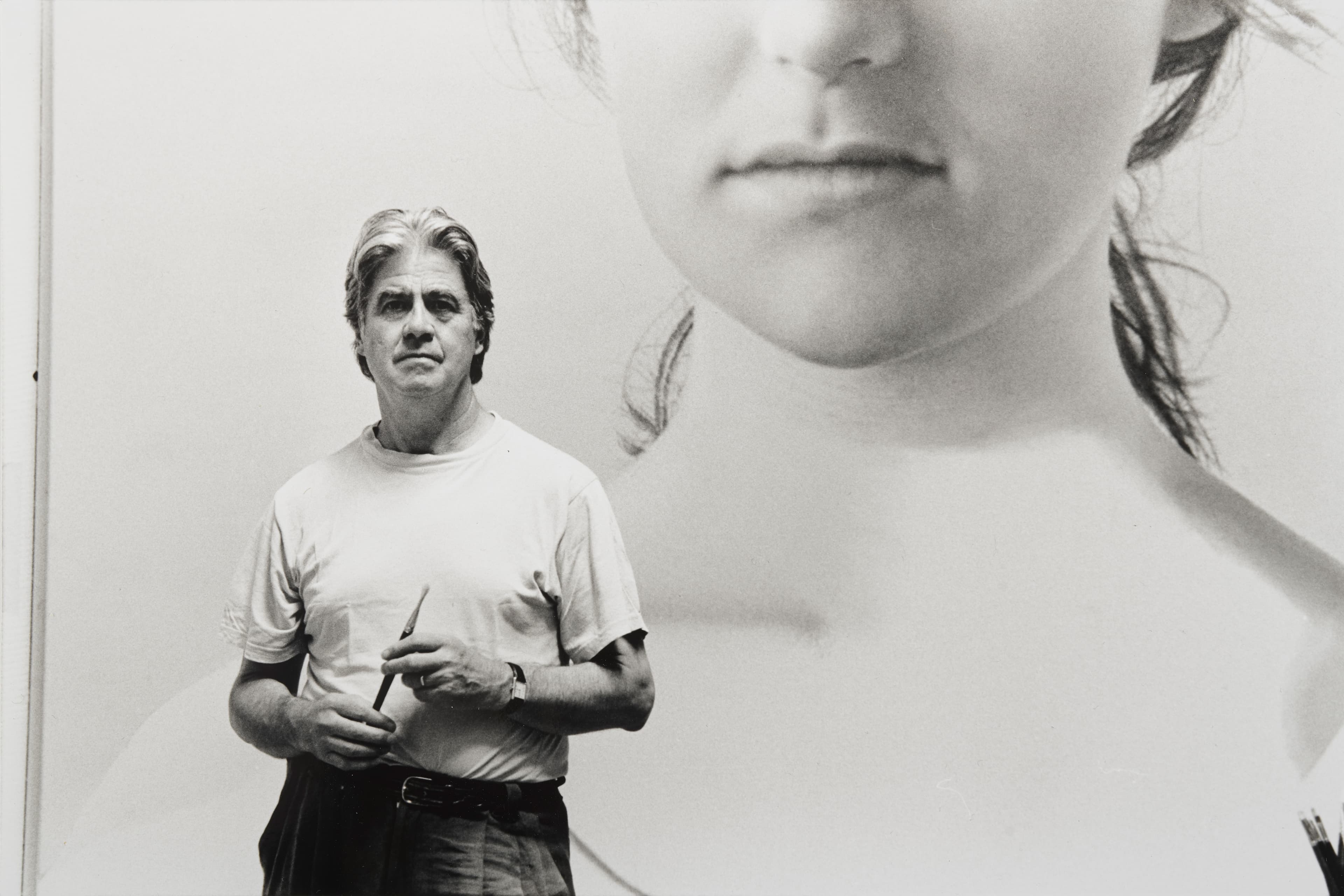
1930
Franz Gertsch was born on 8 March in Mörigen, on Lake Biel. Five years later, the family moved to Bern.
1937–1940
Hans Gertsch frequently took his son to the art museum, which would leave a lasting impression on Franz and in particular works by Ferdinand Hodler and Paul Klee.
1947–1952
Gertsch attended the art school run by Max von Mühlenen, a renowned modern painter in Bern. He subsequently studied the techniques of the Old Masters under the Bern artist Hans Schwarzenbach and had access to his extensive library of art history.
1955
Gertsch married Denise Kohler who he had a daughter with, Renate Suna.
1955–1960
Gertsch experienced a creative crisis that included periods of depression and a lack of direction.
1963
Franz Gertsch divorced Denise Kohler and married Maria Meer. Their daughter Silvia Maria was born; in the subsequent years, another daughter, Hanne-Lore, and two sons, Hans Albrecht and Bendicht Mattia, follow.
1966
Gertsch began drawing inspiration from the contemporary and figurative qualities of Pop Art. He created some initial collages of family scenes, painted freely in gouache, which he later translated into large-scale works using emulsion paint.
1967
Gertsch created collages and paintings based on photographs from popular magazines featuring, among others, Bob Dylan, Mick Jagger and the Rolling Stones.
1969
Gertsch reached an artistic dead end, producing nothing for several months. He abandoned abstraction and began translating photographs into paintings. Large-scale, realist paintings were created based on imagery from the media and his own photographs, which he projected as slides, rendering them in paint on canvas in the light of the projection.
1970
Gertsch began painting portraits of his family and artist friends.
1971
The Swiss curator Jean-Christophe Ammann organised the first major solo exhibition of Gertsch’s work for the reopening of Kunstmuseum Luzern in 1972. During the preparations, Gertsch became acquainted with the art student Luciano Castelli and his friends.
Gertsch rented a huge loft at the Gassner brewery in Bern to work on his monumental paintings on bedsheets that had been sewn together. He began with group portraits such as Maria mit Kindern (Maria with Children) and Medici.
1972
The collector Peter Ludwig acquired Medici. Gertsch participated in documenta 5 in Kassel where Medici was greatly admired.
1973
Gertsch attended parties hosted by Luciano Castelli and his friends at their shared house on Reckenbühlstrasse in Lucerne. The photographs taken there inspired a new series of works.
1974–1975
Gertsch received a grant from the German Academic Exchange Service and moved to Berlin with his family for 18 months.
1976
Gertsch moved with his family into an old farmhouse in Rüschegg, in the canton of Bern, where he continued to live until his death.
1977–1978
Gertsch photographed Patti Smith during a performance; the shots result in the images Patti Smith I–II, which were exhibited at the Venice Biennale in 1978.
1980
Gertsch painted Selbstbildnis (Self Portrait) based on a photograph taken by Maria Gertsch-Meer, marking the beginning of a portrait series. Over the next six years, he painted six large portraits of women.
1988–1993
Gertsch began working on woodcuts and temporarily stopped painting. Gertsch turned to nature in his new large-scale woodcuts, finding inspiration in the immediate surroundings of his home in Rüschegg.
1995–1999
In the summer of 1995, inspired by inconspicuous grass at the edge of his garden, Gertsch began painting again.
1999
A solo exhibition at Venice Biennale.
2002
The opening of Museum Franz Gertsch in Burgdorf.
2005–2006
Opening of his retrospective, a joint exhibition by Museum Franz Gertsch (works up to 1976) and Kunstmuseum Bern (works from 1977–2005). The exhibition subsequently travelled to Ludwig Forum für Internationale Kunst, Aachen, Kunsthalle Tübingen as well as the Albertina and mumok (Museum moderner Kunst Stiftung Ludwig) in Vienna.
2011
Solo exhibition at Kunsthaus Zürich.
2011–2013
Gertsch worked on the triptych Guadeloupe. The photographs that provided the source were from a trip that Franz Gertsch and Maria Gertsch-Meer had taken to Guadeloupe in 1985.
2018–2021
With Gräser V–VII (Grasses V–VII) Gertsch gradually moved away from using realistic colour. By using pure lapis lazuli as the only pigment for Gräser VIII–IX, Blauer Sommer (Blue Summer), Blaue Pestwurz (Blue Butterbur)and Blauer Waldweg (Campiglia Marittima) [Blue Forest Path (Campiglia Marittima)] he achieved the monochrome palette he had been striving for in his painting.
2020
On the occasion of the artist’s 90th birthday, Museum Franz Gertsch and Lentos Kunstmuseum Linz organised an exhibition focusing on his work from the 1970s.
2022
Franz Gertsch died on 21 December at the age of 92. He is buried in the Rüschegg cemetery.
Early Works
Franz Gertsch did not find his way into painting using a direct route. After initially studying under Max von Mühlenen (1903–1971), whose moderately abstract art ultimately felt foreign to his artistic temperament, he moved on to the painter and graphic artist Hans Schwarzenbach (1911–1983). Schwarzenbach taught Gertsch such old master techniques as egg tempera applied in layers of glazing, awakened his interest in historical pigments and instilled in him an admiration for the Flemish masters – a preference that would leave a lasting mark on Gertsch’s own development.
Influenced by a trip to Florence in 1953, where he immersed himself in works of the early Renaissance, a naturalist style began to permeate his painting. From 1954 onwards, he produced primarily still lifes and landscapes, mostly in egg tempera or mixed media, executed using a fine brush and with old master precision. To these he added mythological and fairy-tale subject matter, reflecting Gertsch and his friend, the folklorist and mythologist Sergius Golowin’s (1930–2006) shared interest in the supernatural and fantastic.
Parzivals Aufbruch (Parzival’s Departure) is an emblematic painting of inner tension. The almost contemplative, only partially coloured scene in the foreground is set against the harsh, flat red of the background. Yet the optimistic title is belied by the figure of Parzival, lost in melancholy reverie – it is tempting to see in this dreaming figure an alter ego of the artist himself.
The high point of the Magical Realism of these years is Bach im Mondschein (Stream in Moonlight). Gertsch depicted the Reichenbach stream by night, painted entirely in greys using the grisaille technique. The stones bathed in white moonlight, the delicate silhouette of a solitary honeysuckle, while the grey-on-grey stippled leaves and branches lend the scene a visionary intensity.
Der Maler (The Painter) marks a different kind of departure. The traditional subject of painter and model has been radically simplified: flat forms, harsh colours and a pictorial language already anticipating the transition to his later collage work. The painting is also a self-portrait: the shadow of the painter concealed behind the curtain is a self-portrait of Gertsch, while the female nude is a portrait of his wife Maria. On the stack of books to the left lies his Tagebuch eines Malers (Diary of a Painter), published by Stämpfli in 1965 – the fictional journal of an artist in the grip of a deep creative crisis, in which Gertsch employs a generous dose of self-irony in describing his own situation. Together, the Diary and the painting mark his farewell to his romantic period, to the mythological and fairy-tale subjects that had defined his early years.
Pop Art
During the mid-1960s, Franz Gertsch discovered a new visual world – and with it a new method. Pop Art, which he studied intensely in 1966, showed him a way to translate contemporary reality into painting: directly, with unapologetic intensity, while not shying away from the quotidian. Gertsch himself was clear about what was driving him: ‘I didn’t want to paint a girl reading a book or a shepherd boy playing the flute, but something that really matters to young people between 16 and 20.’
His sources from this point onwards were photographs from music magazines and popular magazines: Bob Dylan and Joan Baez, Mick Jagger and the Rolling Stones, Françoise Hardy on a Formula 1 racing car, young models in miniskirts. Such imagery was circulating in vast quantities – their subjects were young, alive and unmistakably of their time. Gertsch first translated them into collages of coloured paper, subsequently rendering them with emulsion paint on a large scale. Through the reduction to a few colours and clear contours, the figures acquired a peculiar presence: familiar and remote at once, iconic and fleeting.
That Gertsch also understood his own life as being a source for pictorial material is evident in the paired figures on display in this space. A casually seated male figure combined with a reclining female figure, for which his wife Maria served as model – it was from such elements that Gertsch was able to distil images stripped of everything anecdotal. He referred to the figures simply as ‘pair’, or identified them only by date. What remains are prototypes of the youthful spirit of the era, whose contemporaneity is felt solely through the ease of their poses.
The motif of a reclining couple enabled Gertsch both to win a competition in 1967 and become engulfed in a scandal. He was awarded first prize to create a mural for the new secondary school and teachers’ college in Langenthal, only to have the prize revoked on account of the controversial subject matter. A heated dispute between opponents and supporters played out in the regional press. By April 1968, Jean-Christophe Ammann – at the time assistant to Harald Szeemann at Kunsthalle Bern – was able to restore the artist’s damaged reputation, writing in the journal Werk, he honoured Gertsch as part of the young Bern avant-garde.
In October 1968, Gertsch showed his most recent works at the progressive Galerie Martin Krebs in Bern, one of the few venues in Switzerland to have committed itself wholeheartedly to Pop Art, which was still considered provocative. A newspaper review admiringly stated: ‘Franz Gertsch confuses neither through novel techniques, nor through new materials or forms; he shocks, in the best sense of the word, through a stupendous simplicity of representation, through a perfectly clear pictorial statement.’
First Photorealist Paintings
Franz Gertsch’s turn towards Photorealism was the result of an ongoing process. His route had led through a traditional training and his encounter with Pop Art during the 1960s, which opened up the world of everyday life as a legitimate source of imagery. The decisive breakthrough came in 1969 with the painting Huaa...!, whose title can be read as a kind of overture to the success that would follow.
The catalyst was a visit to the cinema. Michelangelo Antonioni’s film Blow Up (1966) made a lasting impression on Gertsch, not least because of its lead actor David Hemmings. When Gertsch shortly afterward came across a film still from The Charge of the Light Brigade (1968) in a French music magazine – also starring Hemmings – he was immediately captivated. The image shows a British cavalry officer in the Crimean War, riding to his certain death following a senseless order to attack. Although based on historical events, the film was widely read in 1968 as a trenchant commentary on American policy in Vietnam. Gertsch photographed the magazine image, projected the small slide onto a large canvas and painted from it as his source. His blow-up technique was born.
The two other works on display in this space demonstrate how consistently and versatilely Gertsch pursued this new approach. Vietnam is based on a documentary photograph by John Olson depicting the Battle of Hué on February 15, 1968, as published in Life magazine. Gertsch treated this world historical image with the same unflinching directness as he had the film still.
Junkere 37, by contrast, turns the lens on Gertsch's immediate surroundings in Bern. The basement venue of the same name on Junkerngasse was, from 1964 to 1975, the most important meeting place for Swiss nonconformists: over 300 evenings of discussion provided a platform for writers and thinkers such as Theodor W. Adorno, Peter Bichsel, Kurt Marti and many others. A snapshot taken in the space became the third work in this group. Fiction, world history and local chronicle: three sources, three states of current affairs and one singular, unmistakable method.
Family Pictures
From 1969 onwards, Franz Gertsch no longer drew on external sources of imagery. Recognising that narrative and contemporary content merely distracted from his actual goal – creating true images of the world as it appeared – he decided to start producing his own photographic sources. He acquired professional cameras and, with the help of his photographer friend Balthasar Burkhard (1944–2010), learned the necessary skills. His gaze turned inwards: towards his own family, towards quotidian moments that appeared as if they had never been meant to last.
The three works in this space could be pages from a family album. Brecht, Hanne-Lore, Silvia shows the artist’s three children in the bathtub – a fleeting, intimate snapshot of family life. Maria und Benz (Maria and Benz) captures the artist's wife and their son at a picnic. Maria mit Kindern (Maria with Children) gathers the family in another of these quiet, private moments. What unites these paintings is their immediacy, showing life as it is, unstaged and close.
This kind of family imagery had no precedent in 20th century Swiss art. The candid intimacy of the snapshot, the unselfconsciousness of childhood, was not an established subject of painting. Gertsch made it one – and he did so in the spirit of his time. In the early 1970s, shaped by hippie culture and an uninhibited relationship with the body, such openness was an expression of freedom and naturalness.
Yet Gertsch was translating this intimacy into a monumental scale. He painted in the light of the projected slide, which cast the snapshot onto the large canvas. What began as a fleeting moment became a haunting painting. The enlargement changed everything: a casual instant gained weight, a private image became a universal experience.
What the paintings do not show, the family archive preserves. The photographs from those years that served as Gertsch’s source material are on view exclusively in this exhibition space – displayed directly alongside the works that developed from them.
Circle around Luciano Castelli
‘Three times I was an onlooker, an old man of 42, in the shared house of young friends around Luciano Castelli’, was how Franz Gertsch himself described his role at Reckenbühl, a villa on the hillside above Lucerne that the twenty-year-old Castelli had shared since 1970 with his friends Franz Marfurt and Ueli Vollenweider. Surrounded by stately old properties, Reckenbühl became the stage for un-quotidian everyday life: wild parties, outlandish outfits and playful masquerade. Its inhabitants tested the dissolution of accepted conventions, the blurring of boundaries between art and life, male and female, self and other – embodying one of the most radical social upheavals in 1970s Switzerland.
Gertsch was not present as a fellow reveller. With open curiosity he observed the circle of friends eating, drinking, reading, listening to music and dressing up, capturing moments before and after the parties with his camera. He avoided any exploitative voyeurism: non-judgmentally, he remained open to the ideas of his protagonists and shared their hunger for reinvention. This unconditional way of looking, which is never superficial, transformed fleeting instants into incomparable monuments of the zeitgeist.
At Luciano’s House shows Barbara, Luciano and Marina dressing and putting on makeup before a party. Their extravagant clothing and painted faces have something clownish and at the same time profoundly serious about them – nothing less than the transformation of the self is at stake. Marina schminkt Luciano (Marina Making Up Luciano) distils a moment of glamorous self-staging and gender-fluid identity still further: Marina, her hair pulled back severely, projects a cool decisiveness, while Luciano, with his long curly hair, surrenders entirely to the act of being made up.
Luciano I shows the young man in a different situation: alone at a table, before him the remains of an opulent dinner – overturned glasses, cigarette stubs and used crockery. Luciano sits quietly, hands loosely folded, his gaze directed downwards – the composed figure before the chaotic table, a contrast that captures the full energy of the community in a single image.
The Blue Room
In his final paintings, Franz Gertsch returned to a colour that has captivated art history for centuries: blue. Five works were painted using lapis lazuli pigment, one of the most precious and luminous blues in existence. Three of them are on view here: Gräser VIII (Grasses VIII), Blauer Sommer (Blue Summer), and Blaue Pestwurz (Blue Butterbur). They are monochrome paintings, departing from all local colour, something Gertsch had prepared for in producing his woodcuts but was now carrying out in painting for the first time with complete consistency.
On the making of these works, Gertsch recalled: ‘One day in November 2019, Peter Iseli visited us and saw that I was working on a painting using exclusively the colour of the lapis lazuli stone. The next day a letter arrived in the mailbox. Inside were the wise words of an eighteenth-century apothecary: “Lapis is also beneficial for the brain and therefore very favourable against madness, dizziness, palpitations, melancholy and other mental illnesses.” The lapis painting was nearly finished. I had already discovered the first snowdrops around the house and blue-eyed hepatica at the edge of the forest when I felt quite clearly the healing power of the blue stone, since the gloomy, heavy days of winter were now behind us.’ For Gertsch, the healing power of lapis lazuli was no mere theory, it was a lived, sensory experience. At the same time, the paintings reach back into a rich cultural history: blue is the colour of the Virgin’s mantle, the colour of Fra Angelico and Vermeer and also of Yves Klein from 1960 onwards. In Gertsch, however, the blue remains grounded, transforming the imagery of growth and vegetation into an imaginary, dreamlike construction.
The three paintings unfold an internal logic. In Blaue Pestwurz (Blue Butterbur), the broad leaves covering the ground lie flat within the picture plane affirming the painting’s surface, resting upon it. In Gräser VIII (Grasses VIII), by contrast, the narrow, tapering leaves and elongated stems lift away from the uniform blue ground and cut through it with the sharpness of a blade. The picture plane is simultaneously confirmed and destroyed.
Blauer Sommer (Blue Summer) is the consequence – and most profound of the works. The painting was made when Gertsch was ninety years old, from a photograph of dense undergrowth with young trees. Physical frailty transferred directly into the paint: short, back-and-forth strokes of a small brush and softly bound forms. Yet the painting turns weakness into strength. The restless movement of the brush becomes a seismographic record of an image that seems to tremble. Radiant dark zones of ultramarine blue alternate with bright, unpainted areas – darkness and luminosity determining one another. Blauer Sommer closes the final chapter in Franz Gertsch’s work.
Scenes by the Sea
‘On 22 May 1971, Maria and I drove through the night in our old Fiat sedan to Saintes-Maries-de-la-Mer. After a violent morning storm, the sky cleared and we reached the small town where every year the Roma carry the Black Sara in procession to the sea. When we got out of the car, we saw Roma girls playing on the beach and in the shallow water in their pretty dresses and for whom the seashore clearly had more to offer than the procession.’ This was how Franz Gertsch recalled the moment that would never let him go. He had his camera with him and photographed unstaged snapshots of lived experience, his gaze directed outwards, towards an unfamiliar, fleeting scene under southern light.
It was from these photographs that large-scale paintings emerged in the years that followed. Saintes Maries de la Mer I and Saintes Maries de la Mer III are characteristic of Gertsch’s Photorealism: the motifs are unstaged, life is shown as it is lived. The girls in their festive clothing, the sea in the background, the casualness of the moment and yet, translated into monumental scale becomes a presence that stops the viewer in their tracks. With Saintes Maries de la Mer III, Gertsch also made an important shift in his use of materials: for the first time he painted on unprimed cotton, which he had discovered in an art supply store on Canal Street in New York. The densely woven cotton offered resistance; the paint had to be dabbed and massaged in with blunt bristle brushes. ‘Slow painting had begun’, Gertsch noted.
But Saintes-Maries-de-la-Mer left a different, deeper trace in Gertsch. On that same day, he also photographed the churned-up sea after the storm, but without figures. He intended to translate it into a painting at the end of 1972, but abandoned the work, ‘perhaps because I missed the living presence of a human being.’ Decades later, an old, faded print came into his hands. He had a slide made from it and returned to the long-deferred image. The result was Meer I (Sea I) an atmospheric seascape that eschews the human figure entirely, making the landscape itself the subject.
Meer I conveys Gertsch’s entire body of work within it. ‘My paintings are hybrids’, he said, ‘half real and half abstract. From a distance, photographic reality; from close up, abstract painting.’ In the uninhabited seascape, this tension reveals itself with particular clarity. And with it, as Gertsch put it, ‘we have come full circle.’
Botanical and Human Living Entities
In the 1980s, Franz Gertsch withdrew from the city. At an altitude of 900 metres, on the Alpine foothills, he found a new visual world – and a new approach. ‘When we moved to the countryside in 1976’, he recalled, ‘I enjoyed the peace and the beauty of the nature surrounding us. But at some point the urban motifs dried up and I looked around for new sources. It was already the time of the woodcuts when the mystery of nature began taking hold of me.’
What followed was a deliberate turn toward beauty – a conscious countermovement in an art world that prized above all innovation and critical cognisance. Gertsch was familiar with the disciplining power of beauty: ‘I have dedicated myself to beauty because the representation of beauty is enhanced through painting, which can be beautiful only when it is good.’ His gaze turned from this point onwards to what he had dubbed ‘living entities’ – human and botanical sources treated with equal attention and dignity. No subject is prioritised more than any other. Human being and nature are equal presences within a single reality that Gertsch was able to capture in monumental paintings.
This worldview finds its most concentrated expression in the Guadeloupe Triptych, a homage to his wife Maria Gertsch-Meer. The large-scale nude portrait Maria (Guadeloupe), painted from a photograph taken in 1985, occupies the centre – yet not as a focal point subordinating everything else. The naked, dreaming woman is embedded within a play of shadows, warm sand, and the protective root system of coconut palms. To her left, in Bromelia (Guadeloupe), the graceful red blossoms of a bromeliad reach upward into the luminous green Caribbean landscape. To her right, the tropical marshland spreads at the foot of the volcano in Soufrière (Guadeloupe). A web of lines – shadows, silhouettes, branches and lianas – runs through all three paintings, binding them into an energetic field of fertility. Without any one of the three, the whole would lose its balance.
The two depictions of butterbur from 2014 and 2018 carry such thoughts further. The plant’s sweeping leaves, in close-up and translated to a monumental scale, are no mere decoration – they are living entities in their own right. In Gertsch’s non-judgmental, non-hierarchical gaze at human beings and nature, a worldview manifests itself that reaches far beyond the painterly: the human being does not stand at the centre. It is part of a whole.
Playlist
Play it like Gertsch! Listen to the music that accompanied Franz Gertsch and discover the exhibition with his personal soundtrack.
Imprint
Franz Gertsch. Blow-Up (Part I)
Kunstmuseum Bern
14.8.2026–17.1.2027
Curator: Dr. Kathleen Bühler
Assistant curator: Nina Liechti
Exhibition catalogue: Franz Gertsch. Blow-Up, edited by Kirsten Degel und Lærke Rydal Jørgensen, Hatje Cantz Publishers, Munich 2024. With contributions by Tobia Bezzola, Kathleen Bühler, Florian Illies, Dora Imhof and Ulrich Loock, as well as a conversation between Franz Gertsch and Hans Ulrich Obrist
Exhibition design: Salzmann Gertsch
Audioguide
Realisation: tonwelt GmbH
Digital Guide
Implementation: NETNODE AG
Project: Cédric Zubler
With the support of:






Media partner:

Kunstmuseum Bern
Hodlerstrasse 8–12, 3011 Bern
+41 31 328 09 44
info@kunstmuseumbern.ch
kunstmuseumbern.ch/en/gertsch


