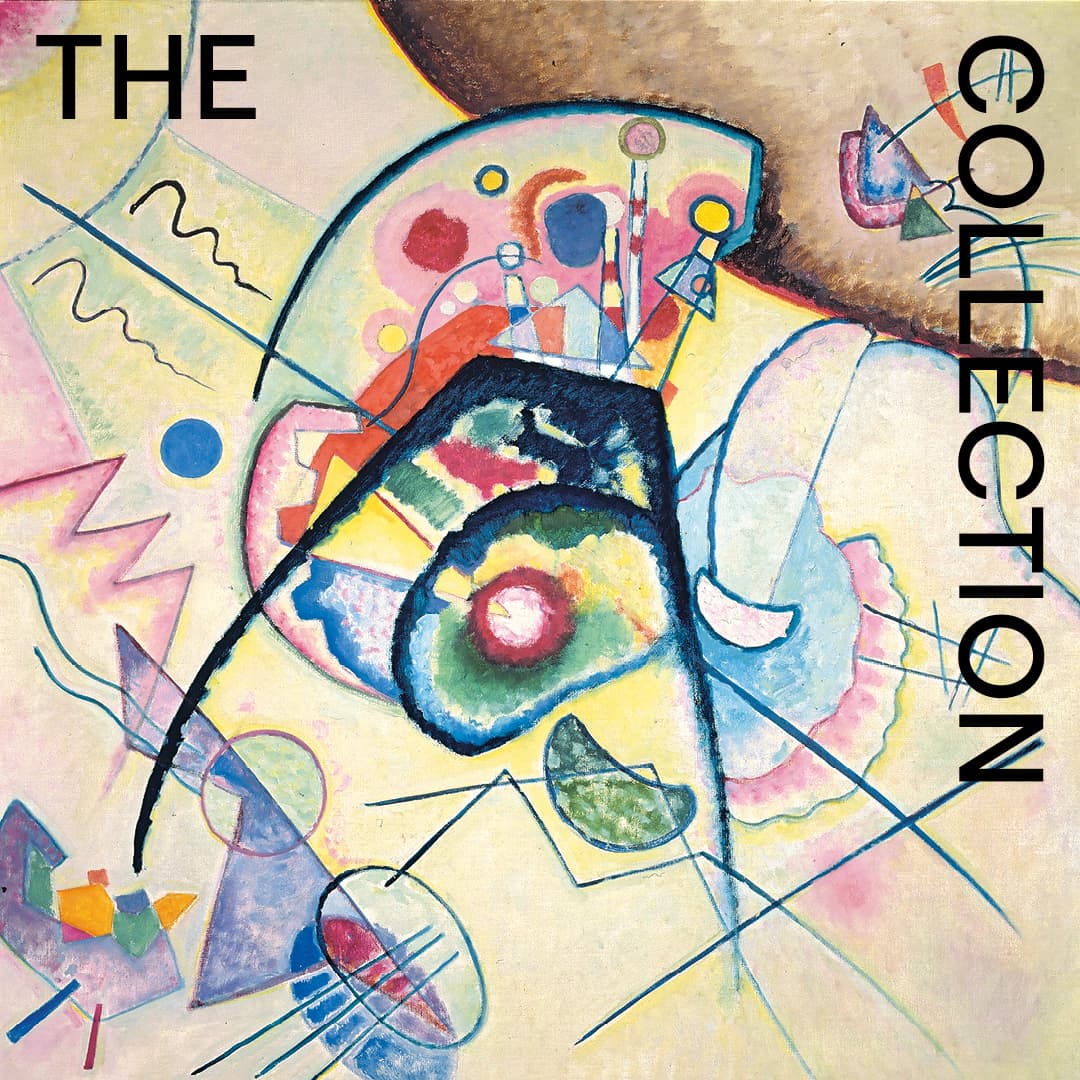
The Collection. From Fra Angelico to Pablo Picasso, from Ferdinand Hodler to Meret Oppenheim.
Introduction
Kunstmuseum Bern houses an important art collection spanning the late Middle Ages to the present day. The collection’s display features selected works in rotating displays.
Old Wing
The basement level features Modernism’s key avant-garde movements: Cubism, Expressionism, Surrealism and abstract art. Highlights include Pablo Picasso’s Violon accroché au mur, Meret Oppenheim’s Verzauberung and Piet Mondrian’s Tableau No. II, with Black and Grey. The display is complemented by a selection of works by the Bern artist Adolf Wölfli from the holdings of the Adolf Wölfli Foundation.
Two ground-floor galleries are dedicated to works by Swiss artists of the 19th and early 20th centuries. These include Ferdinand Hodler’s renowned Symbolist paintings Die Nacht and Der Tag as well as works by Albert Anker and Arnold Böcklin. Two smaller galleries showcase highlights of Impressionist and Post-Impressionist painting, including Paul Cézanne’s Portrait de l’artiste au chapeau à large bord, Vincent van Gogh’s Tournesols fanés and Henri Matisse’s La blouse bleue.
New Wing
The basement level juxtaposes paintings by renowned representatives of Abstract Expressionism – such as Jackson Pollock’s Brown and Silver II and Lee Krasner’s Forest No. 2 – with works of abstract and Concrete Art, such as those by Sophie Taeuber-Arp and Max Bill.
Adolf Wölfli (1864–1930)
Adolf Wölfli is considered one of the most important representatives of Art brut. He began drawing, writing and composing at the age of 35 in the Waldau psychiatric clinic near Bern. Since 1975, his extensive estate has been administered by the Adolf Wölfli Foundation, which analyses it scientifically and makes it accessible to the public in publications and exhibitions.The foundation has been housed in the Kunstmuseum Bern since its inception. In this room, it presents various aspects of Wölfli's work in changing presentations.
How do I read a provenance label? A guide
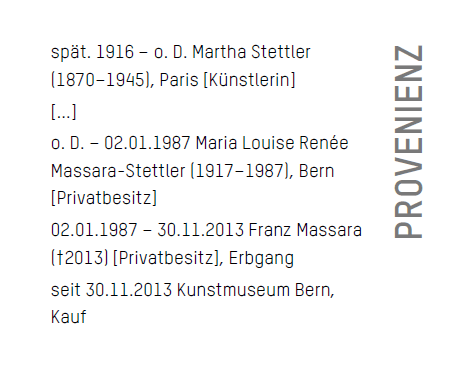
Works from Kunstmuseum Bern’s collection are generally accompanied by provenance labels. These supplement the work labels and provide information about the history of a work of art – that is, about its previous owners from the time of its creation until its entry into our collection.
Each line of a provenance label indicates a change of ownership and contains, if known, the following information:
- Date information: period of ownership; unknown dates are indicated with 'o. D.' ('ohne Datum', no date).
- Ownership: this can refer to a person or an institution (e.g., a commercial gallery or museum). If there is any uncertainty regarding ownership, this is indicated by the word 'wohl' ('probably') at the beginning of the provenance entry.
- Capacity as owners: for example, whether they are collectors or art dealers.
- Mode of transfer: how ownership changed (e.g., purchase, inheritance, bequest).
If the owner remains unknown for a certain period of time, such a gap in knowledge is indicated by […].
Exhibitions and auctions are generally not included on provenance labels. These are listed, however, when for example, ownership remains unknown for an extended period of time and the appearance of a work of art at an auction or exhibition provides the only clue to its location.
All the information is based on the current state of research and will be updated as new findings emerge. Kunstmuseum Bern’s provenance research focuses on works of art that changed ownership during the Nazi regime (1933–1945). These works may include art looted by the Nazis. For works that entered the collection before 1933, the date of acquisition is indicated; works created after 1945 do not receive a provenance label.
Imprint
The Collection
Kunstmuseum Bern
Curator: Anne-Christine Strobel
Digital Guide:
Implementation: NETNODE AG
Project: Andriu Deflorin, Cédric Zubler
With the support of:
Pierre Kottelat
KUNSTMUSEUM BERN
Hodlerstrasse 8–12, CH-3011 Bern
T +41 (0)31 328 09 44
info@kunstmuseumbern.ch
kunstmuseumbern.ch/TheCollection


