
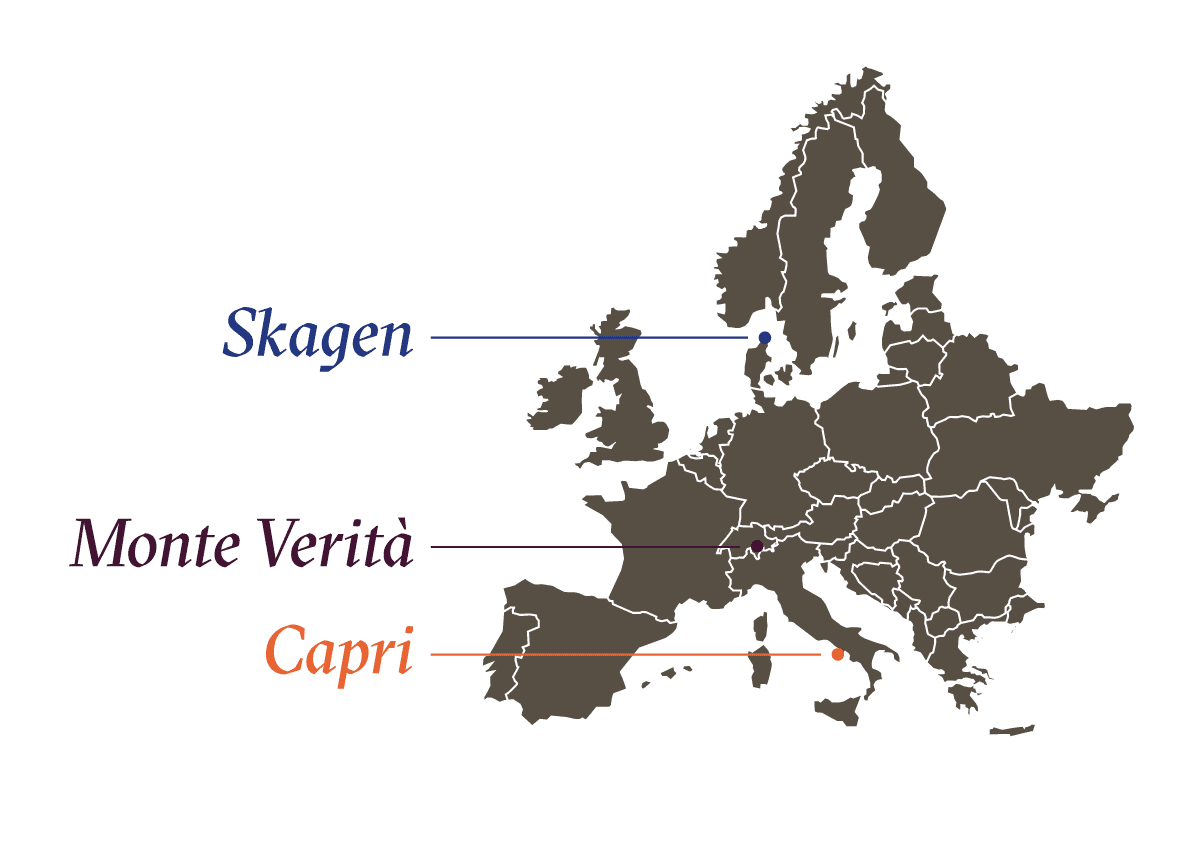
Capri
16°C
Skagen
12°C

Monte Verità
13°C
Start of the Journey
Three places, one promise – freedom. Between 1830 and 1930, artists from all over Europe flocked to the continent’s peripheries – to Capri in southern Italy, to Skagen in northern Denmark but also to Monte Verità in Switzerland. Remote from industrialised cities and bourgeois constraints, they were seeking a different life, closer to nature, closer to what they considered “real”.
Three places, all distinctly unique – Capri, an island in the Gulf of Naples overlooking the Amalfi Coast and Mount Vesuvius, was considered a sensual, Dionysian Arcadia. In Skagen, where the North and Baltic seas converge, many felt close to the elements, believing they were perceiving the world anew. Monte Verità, on the other hand, was a stage for the reimagining of life, a place where the art of living was regarded as the highest art.
Three places, but one feeling – that a freer life must be possible elsewhere. The exhibition explores such a yearning and the disillusionment. Those who were embarking on longer sojourns were able to see beyond the postcard – fishermen risking their lives, women, children and the elderly working hard, poverty. The ostensibly untouched nature of such places will always be an outsider’s perspective, that of an artistic avant-garde. And yet, it was precisely this friction between utopia and reality that enabled something unprecedented, something radical to emerge.
I. Capri: Arcadia in the Mediterranean
Even in the early 19th century, Capri was more than just a destination, it was a promise. The warm light, untamed nature and the ancient Roman ruins drew artists from northern Europe to the island. They were seeking Arcadia – not merely as a pastoral idyll, but as a sensual, Dionysian dream. A place of intoxication, the corporeal and uninhibited joie de vivre, far removed from grey metropolises and societal conventions.
The rediscovery of the Blue Grotto in 1826 by German painters fuelled the myth. The cave’s luminous blue corresponds to the blue flower, the symbol of romantic longing par excellence. Numerous creative individuals and intellectuals – including Louis-Léopold Robert and Alma Mahler-Werfel – soon transformed the rugged island into a cosmopolitan haunt.
One of its sights was the ruin of Villa Jovis, residence of the Roman Emperor Tiberius (42 BC – 37 AD), who ruled his empire from there during the last ten years of his life. He was notorious for his cruel and uninhibited lifestyle and his orgies. He had those condemned to death hurled 300 meters down the Salto di Tiberio.
Political dissidents likewise flocked to Capri. Under the supervision of the author Maxim Gorky, Vladimir Ilyich Lenin and Alexander Bogdanov played chess on the terrace of Villa Rosa in 1908. But such harmony was destined not to last. When Gorky and Bogdanov founded the “school of the revolution” a year later, Lenin was no longer involved.
II. Capri: Life Beyond Postcards
For the fishermen, there was no Arcadia. They pulled in their nets, mended and cast them again – just as their fathers and grandfathers had before them. Increasing tourism brought in money, but it did not directly eliminate poverty, only rendering it more picturesque.
Edmond-Jean de Pury was one of the first to make careful observations. He portrayed fishermen as well as hardworking women and children with compassionate dignity. Elise Mahler painted not only the famous Faraglioni in golden light, but also the austere stone huts on the hillside, the simple dwellings of fishers, farmers and shepherds, and their families.
The local population quickly discovered that the artists were a source of income. Young women went barefoot to the hotels with baskets full of coral, offering it for sale. Capri and Anacapri profited from the burgeoning tourism. It brought jobs and income, but also higher prices. A gap began opening up between income and the cost of living.
The relationship between the creative individuals, most of them only living temporarily on Capri, and the local population remained ambivalent. Girls and boys allowed themselves to be photographed – usually by artists for cash. Which raised a question: were the transactions in the control of locals or was it more an external exoticising gaze?
III. Capri: An Island of Eccentrics
Capri appeared to many Scandinavian, German and Swiss artists as an alternative world to the “harsh north”. The island became a sanctuary for all those weary of the hectic pace of urban life. Women painted and travelled independently, men loved men. Female self-determination, queer identity, liberated desire: on Capri, lifestyles became possible that would have been persecuted elsewhere.
Karl Wilhelm Diefenbach, the “founding father of alternative movements” and also influential at Monte Verità, lived his vision of a free society on Capri from 1899 onwards. Marie Krøyer and her husband P.S. Krøyer spent part of their honeymoon and study trip on Capri in 1889-1890. They regarded their work as following the motto of the English Romantic poet John Keats:
Beauty is truth, truth beauty – that is all
Ye know on earth, and all ye need to know.
Lively parties took place on Capri, for example at Hotel Pagano and the “Zum Kater Hiddigeigei” cafe. Artists painted the hotel’s interior walls with humorous scenes. Among the many artists, Marianne Stokes was the only woman whose signature can be found under her work. The café served German beer and colonial wares.
Around 1900, Capri became a refuge for people who, elsewhere, faced ostracism or punishment because of their lifestyle. The case of the poet Jacques d’Adelswärd-Fersen illustrates the problematic side of this: Convicted in France of “seducing minors into debauchery,” he lived on Capri with the fourteen-year-old Nino Cesarini at Villa Lysis. He named it after Plato’s work on erotic male friendship.
Sites of freedom like Capri offered women in particular new opportunities. Here they could live out what would have been impossible in their homelands. The painter Ilna Ewers-Wunderwald, with her short hair, cigarettes and self-assured demeanour, challenged the era’s prevailing notions of gender roles. Climbing on Capri, she explored Grotta Meravigliosa.
IV. Monte Verità: The Thrill of Freedom
A mountain overlooking Lago Maggiore, a mild climate – and a radical vision of freedom. When Ida Hofmann, Henri Oedenkoven, Karl and his brother Gustav Gräser founded their sanatorium in Ascona around 1900, they were serious: no meat, no alcohol, no coffee, no corsets. Instead, sun, fresh air, a raw food diet and dress reform clothing. Nature heals. Such was both their mission and liberation.
Soon, dropouts, intellectuals and creative individuals from a wide range of disciplines would be flocking to the mountain to escape capitalism and the constraints of the modern era. They were all seeking the same thing: a life beyond bourgeois order, free from societal norms. Anarchy was more than just a buzzword; Monte Verità meant escape.
The travelling singer and anarchist Erich Mühsam arrived at Monte Verità in 1905 with his friend Johannes Nohl. However, considering the prevailing worldview there irrelevant, he proposed turning the colony into a refuge for released prisoners. He composed a satirical “alcohol-free drinking song”:
The Song of the Vegetarians
We eat salad, yes, we eat salad
And eat vegetables early and late.
Fruits are also part of our diet.
Everything else that grows is spurned.
And if you call the vegetarian a fool,
we'll throw a walnut at your head.
We eat salad, yes, we eat salad
And eat vegetables from early till late.
Guests were accommodated separately in airy, light-filled cabins, where they could feel as if they were living in isolation surrounded by nature. The cabins were sparsely furnished. The only pictures on the walls were the landscape visible through the window. This cabin was built in 1905 and named the “Russian House” in honour of Russian students who fled after the suppression following the uprising.
In 1913, the expressionist dancer Mary Wigman danced on the shores of the as yet undeveloped Lago Maggiore: “We danced with or without music. We danced to the rhythm of poetry, and sometimes Rudolf von Laban demanded that we move to words, sentences and verses of our own making. Such experiments enriched our emotional world”.
V. Skagen: Life Determined by the Tides
Skagen at that time was a poor fishing village, informed by hard work and constant danger at sea. This was exactly why the painters came there from the city. They yearned not only for sublime nature and the Nordic light, but also for “authenticity” – an unfiltered life.
Anna and Michael Ancher closely observed women who would stay at home, selling fish, looking after children and caring for the elderly. Sometimes they would wait in vain for the return of their husbands and sons, who could lose their lives at work. The village community mourns a drowned sailor. The painting references Christian iconography, transforming it into a moving present full of quiet dramas.
Women played a vital role in fishing families. They not only took care of the household and children, but also assumed economic responsibilities. While the men were at sea, they contributed significantly to the stability and cohesion of the family and village community.
Not all the men went to sea. Some were too old, others were suffering from the effects of illness or injury, or were plagued by alcoholism. During a time when there was hardly any state provision for old-age or ill-health, they were cared for by the village community. The artists produced portraits of such marginalised individuals who had nevertheless found their place in Skagen.
VI. Skagen: The Freedom of Painting en Plein Air
It was the invention of the paint tube around 1841 that made plein air painting possible. Artists became able to capture twilight conditions or passing clouds with a new immediacy. For female artists it meant even more, becoming a way to work outside the Royal Danish Academy of Fine Arts in Copenhagen, from which they would remain excluded until 1908.
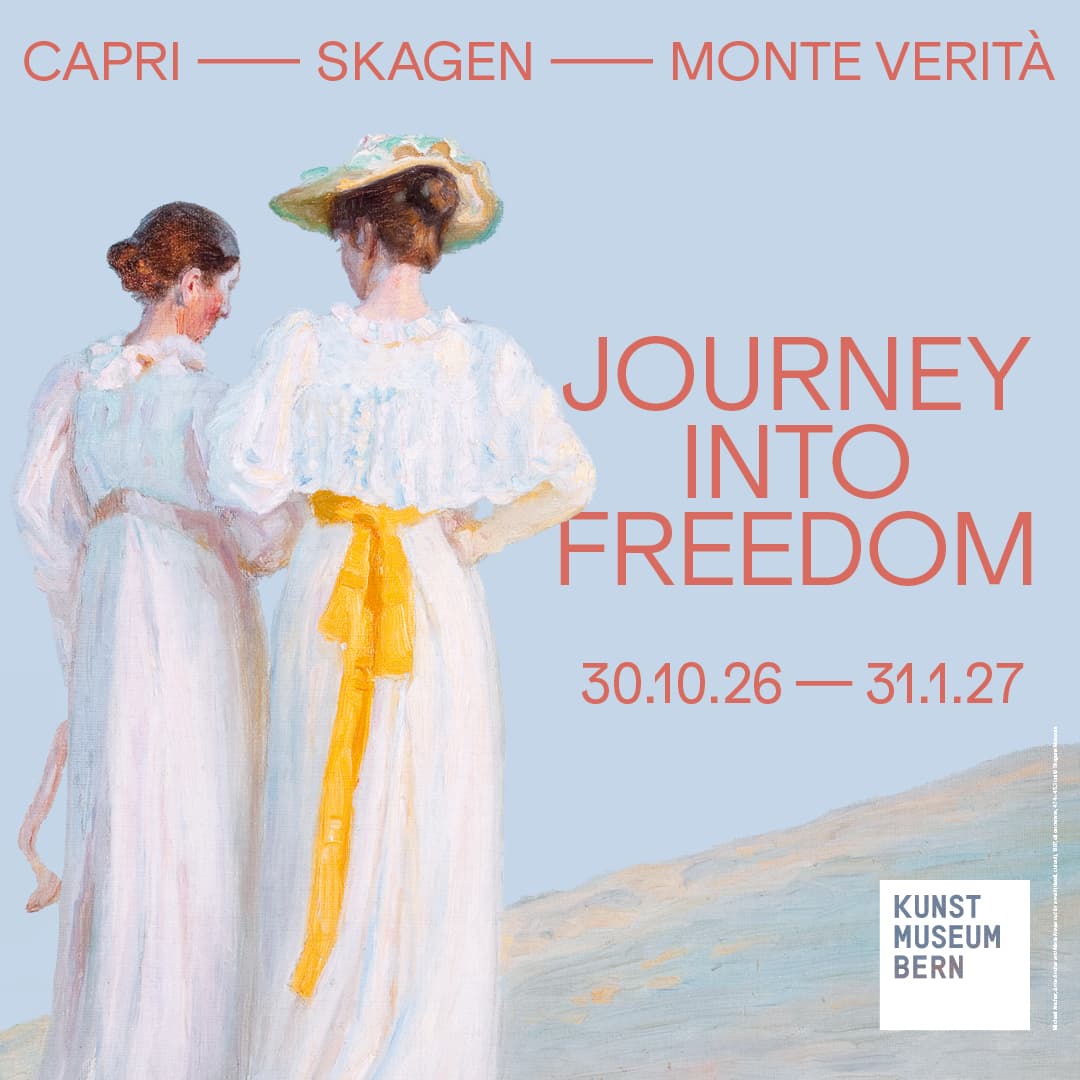
In Michael Ancher’s painting, Anna Ancher and Marie Krøyer stroll along the beach at Skagen. They wear reform dresses which, around 1900, were considered an expression of female liberation. Unlike corsets, such dresses did not constrict the body, representing a new aesthetic and a transformed image of women and the body. Health and movement took centre stage.
Brøndums Hotel in Skagen was a central meeting place in the late 19th century. Artists gathered here to work and exchange ideas. The hotel’s dining room, in particular, became a hub for lively discussions about art, society and new forms of expression.
P.S. Krøyer favoured working outside. For him, “what is painted on the spot in nervous zeal” was preferable to a calm study produced in the studio. According to him he created phenomenally quickly, not overthinking things when sitting outside, knowing “that the mood will be gone in ten minutes”.
The Swiss-Danish painter Bertha Wegmann also visited Skagen during her study trips. However, her breakthrough came in Paris as part of a Nordic network of female artists. Her success as a portrait painter and her partnership with Jeanna Bauck and later Toni Müller demonstrate the realms that women were able to conquer despite all the restrictions.
VII. Skagen: Tempestuous Sea, Forceful Nature
Skagen marks the northernmost point of Jutland in Denmark, where the North and Baltic seas meet. A few mustard-yellow houses with red roofs, a hotel, a church – that is about all there was. Until 1871, the village was only accessible by boat or a dirt track, thereafter a narrow-gauge railway provided a service. The light on the dunes is spectacular, the sea crashing against the shore and the wind whistling through the rugged landscape. From the 1870s onwards, the area began attracting artists from both Scandinavian and German cities.
Fishermen in pitching boats went about their dangerous work, observed by Christian Krohg. They were revered as heroes by the village. Women strolled along the beach, gazing at the horizon, while stopping to have their portraits made by Käte Lassen.
A distinctive feature of Skagen were depictions of fishermen venturing out to sea, risking their lives. The northern sea offered an opportunity of measuring man against nature. The painter and poet Holger Drachmann regarded this positively in 1877. He wanted to transform pampered city dwellers back into tough men.
Teach me to be a man,
Hard-brawling sea!
I lie here alone on the shore,
Listening to your songs.
Though I sink in strife and pain,
I have not yet cowardly fallen,
But only feeble strength is mine.
Air my songs;
Teach me to be a man.
A satirical travel guide stated in 1871 that a railway would probably never reach Skagen. Shortly thereafter, that was to become history. King Christian IX’s nation was seized by a surge of energy. The result could be seen in a toy locomotive that pulled several miniature carriages into Skagen station once a day.
Choose a card. Share your thoughts.
In keeping with the exhibition title ‘Journey into Freedom’, a small room offers a chance to pause and reflect: Visitors can choose a postcard and jot down their thoughts on their own journey, whether for themselves or for others: What do you long for? Where does your heart lead you? When do you feel free?
Imprint
Journey into Freedom. Capri – Skagen – Monte Verità
Kunstmuseum Bern
30 October 2026–31 January 2027
Co-curators: Livia Wermuth & Andreas Schwab
Curatorial Assistant: Kim Hue Luong
Non-fiction book: Zeit der Aussteiger. Eine Reise zu den Künstlerkolonien von Barbizon bis Monte Verità, Andreas Schwab, C.H. Beck, Munich 2021.
Exhibition Design: Katina Anliker, Bureau Boulot
Weather data provided by MET Norway · CC BY 4.0
Digital Guide
Implementation: NETNODE AG
Project Management: Andriu Deflorin, Luisa Viggiano
With the support of:



Media Partner: